
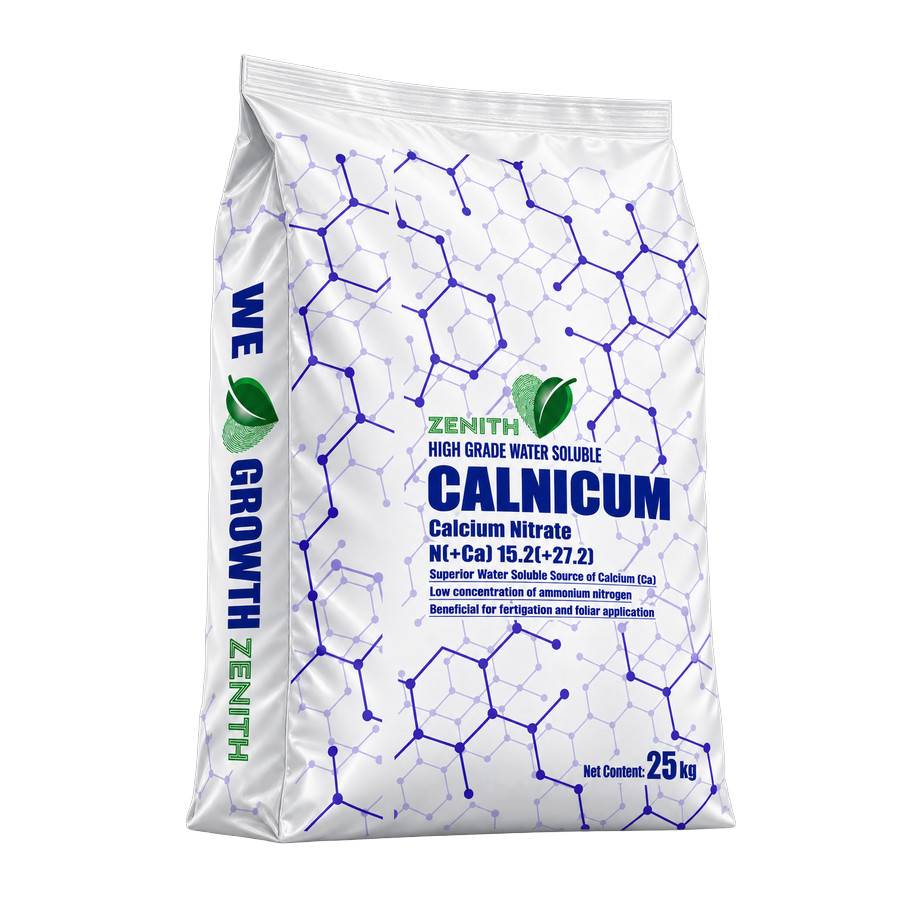
CALNICUM
CALNICUM™ CALCIUM NITRATE FERTILIZERS.
N use efficiency in all parts of plants
- CALNICUM is the preferred inorganic N fertilizer source where soil acidification is undesirable and when both calcium and nitrogen are required to be supplied at the same time. CALNICUM also has an advantage for foliar fertilizer use is a soluble form of calcium. This is very useful in some tree crops, including apples. Applications of CALNICUM exerted marked effect on fruit width, length, shape and width of the ostiole opening. Similar consequences appeared on texture and sugar fractions as fructose, α-glucose, β-glucose and galactose of dried fruits. Calcium Roles: Cell wall and general structure (exceptionally high levels in the middle lamella). Cell membrane function in nutrient transport. Nutrient uptake. Protection from aluminum and manganese toxicity. Plant defense responses. Improved photosynthesis. Root growth, elongation, mycorrhizal fungal promotion, root mucilage production (increasing root contact with soil). Regulating enzyme systems. Water regulation and nutrient balance in plant tissue. Legume nodule structure and nitrogen fixation.
- Calcium helps activate cellular repair and plant defense mechanisms, including selective cell death in advance of a potentially invasive disease that requires living cells and defense chemicals (e.g., phenolics and phytoalexins). High calcium levels also assist plant cells with callose formation, plant cells providing protective barriers to injured plant parts. Calcium improves the function of antioxidants, protecting plant cells from biochemical stresses of cell damage.
SUPERIOR SOLUBLE
CLORIDE FREE SOURCE
IDEAL FOR SALT SENSITIVE CROP
- Calcium deficiency results in structure disintegration such as leaf tip burn, dying ends of shoots, detaching leaf stalks, blossom-end rot (in tomatoes and cucumber family members), and bitter pit (in apples), increasing risk of pests and disease entry. The symptoms reflect the importance of calcium in cell structure and the protective role of calcium against one of the plant’s enzymes that breaks down the pectin layer between cells.
- Nitrate: Needs to be reduced to ammonium (occurs within the roots and shoots of plants and in mycorrhizal fungi). Ammonium is then the source of nitrogen for the amino acid formation and thus all proteins (including enzymes) required by the plant. Many other plant compounds require nitrogen also such as DNA, RNA, ATP, hormones.
More Information
Recommended Dosage
|
Crop |
Optimal time of application |
Kg/ha |
|
Citrus and Orange trees |
Spring application Winter application |
300-600 |
|
Potato |
tuber setting Until tuber filling |
150-300 |
|
Fruit Trees |
flowering time |
300-500 |
|
Pistachio |
By start of vegetation phase During post-harvest time |
300-500 |
|
Banana |
As of plant establishment |
200-500 |
|
Vegetables |
Start of fruit filing |
150-300 |
|
Strawberry |
As of vegetative growth |
150-300 |
|
Grape Tree |
As of leaf bud opening |
150-300 |
|
Watermelon, melon |
As of vegetative growth |
150-300 |
Physical & Chemical Composition
| COMPOSITION |
%W/W |
|
Total Nitrogen (as N) |
15.2% |
|
Nitrate-Nitrogen (N-NO3) |
14.5% |
|
Ammoniacal Nitrogen (N-NH4) |
0.7% |
|
Water soluble Calcium (as Ca) |
19% |
|
Water soluble Calcium (as CaO) |
27.5% |
|
Appearance |
White granular – Flake |
Download Catalog
Here you can download the catalog for this product
Packing
25 kg bag – 1200 kg bigbag
Related Products
Get In Touch or Contact us Anytime
We seek and seize opportunities with our clients. Give us a call or write us an email, we love to grow a solid relationship with you. Let’s get to know each other and grow for the best.
(+49) 55129131818
Zenith@zenith-tech.de