
ZENITH TECH GmbH · Mineral Foliar Fertilizer
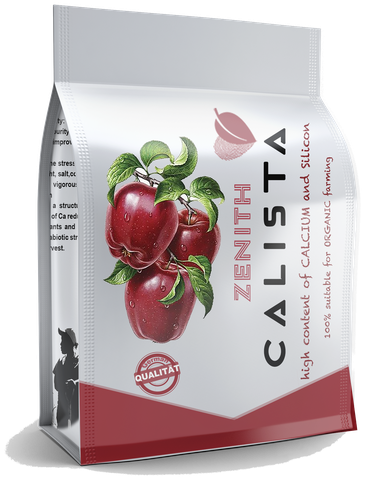
CaO + SiO₂CALISTA
A precision-micronised mineral foliar fertilizer combining calcium oxide and silicon dioxide for synergistic Ca+Si fortification physiology — activating four plant defence mechanisms simultaneously from a single spray.
D₅₀ = 3.61 µm · 100% natural mineral origin · Organic farming approved
Core concept
What is CALISTA?
CALISTA delivers synergistic fortification physiology: Ca²⁺ triggers the plant's own defence signalling cascade while Si builds a permanent physical barrier and upregulates the antioxidant enzyme system. Together they address stress resistance from four distinct biological angles.
Raw material origin: German calcite + natural marine limestone. 100% mineral — no synthetic additives. The micronisation process produces a particle size distribution (D₅₀ = 3.61 µm) specifically engineered to match the stomatal entry threshold, enabling rapid ion delivery to the apoplast within hours of application.
CALISTA can be combined with chelated micronutrient products (Micro Mix) without reducing micronutrient absorption — confirmed by ICP-OES leaf tissue analysis (all Fe, Zn, Mn, Cu, B, Mo: p>0.05 between T2 and T4 treatments).
Calcium (CaO — 30.5%)
Second messenger in plant stress signalling. Activates calmodulin + CDPK kinases → JA/SA defence gene upregulation within minutes. Structural cross-linking of cell wall pectin, reducing softening under heat and pathogen pressure.
Silicon (SiO₂ — 29.7%)
Polymerises on cuticle forming SiO₂-cuticle double layer. Upregulates SOD, CAT, APX and GR antioxidant enzymes by 127–310%. Creates permanent physical barrier against thrips mouthparts and aphid stylets.
Aluminium oxide (Al₂O₃ — 6.0%)
Releases Al³⁺ at apoplast pH 5–6, directly disrupting fungal plasma membranes. 100% Fusarium inhibition at 1 mM in vitro. Ca and Si in the formula chelate excess Al³⁺ — no phytotoxicity to the plant.
Supporting minerals
MgO (2.2%) — chlorophyll synthesis. K₂O (1.15%) — stomatal regulation. S (0.4%) — glutathione sulphur source. Fe₂O₃ (3.4%) — peroxidase cofactor. P₂O₅ (0.2%) — ATP energy currency.
Product specification
Chemical Composition
| Component | Formula | % w/w |
|---|---|---|
| Calcium oxide | CaO | 30.5% |
| Silicon dioxide | SiO₂ | 29.7% |
| Aluminium oxide | Al₂O₃ | 6.0% |
| Iron(III) oxide | Fe₂O₃ | 3.4% |
| Magnesium oxide | MgO | 2.2% |
| Potassium oxide | K₂O | 1.15% |
| Sulphur | S | 0.4% |
| Phosphorus pentoxide | P₂O₅ | 0.2% |
Physical properties
Physical Properties
| Parameter | Value |
|---|---|
| Physical state | Micronised suspension powder |
| Colour | Off-white to light grey |
| pH (1% suspension) | 10.5 – 12.0 |
| Bulk density | 700 – 900 g/L |
| Moisture | < 1.0% |
| Particle D₁₀ | 0.83 µm |
| Particle D₅₀ (median) | 3.61 µm |
| Particle D₉₀ | 13.93 µm |
| Span | 3.64 |
| Max particle size | < 32 µm |
Mode of action
Four Resistance Mechanisms
CALISTA activates four distinct plant defence mechanisms simultaneously from a single foliar application — from the physical surface to the molecular signal level.
SiO₂-cuticle double layer
- Si polymerises on cuticle — permanent barrier
- Thrips mouthparts wear against abrasive Si
- Aphid stylets mechanically blocked from phloem
- Ca²⁺ reinforces cell wall pectin cross-linking
Ca²⁺ and Si signalling
- Ca²⁺ spike → calmodulin + CDPK kinases
- JA/SA pathway → defence gene upregulation
- Si → SOD +127% · CAT +164% · APX +310%
- MDA (membrane damage) reduced by −60%
Enhanced phytochemical defence
- PAL, PPO and POD activities upregulated
- Phenolic and tannin synthesis enhanced
- Al³⁺ at pH 5–6: direct antifungal action
- 100% Fusarium inhibition at 1 mM (in vitro)
Herbivore-induced plant volatiles
- Ca-mediated JA pathway → HIPV emission
- Terpene, green leaf volatile + indole signals
- Attracts parasitoid wasps (Cotesia spp.)
- Activates within 4–8 h of application
Analytical data · CILAS 1190 Laser Diffraction
Particle Size Distribution
Measured by CILAS 1190 Liquid (Fraunhofer model, ISO 13320). Dispersant: water. Obscuration: 24% — within the optimal 10–30% measurement window confirming analytical validity.
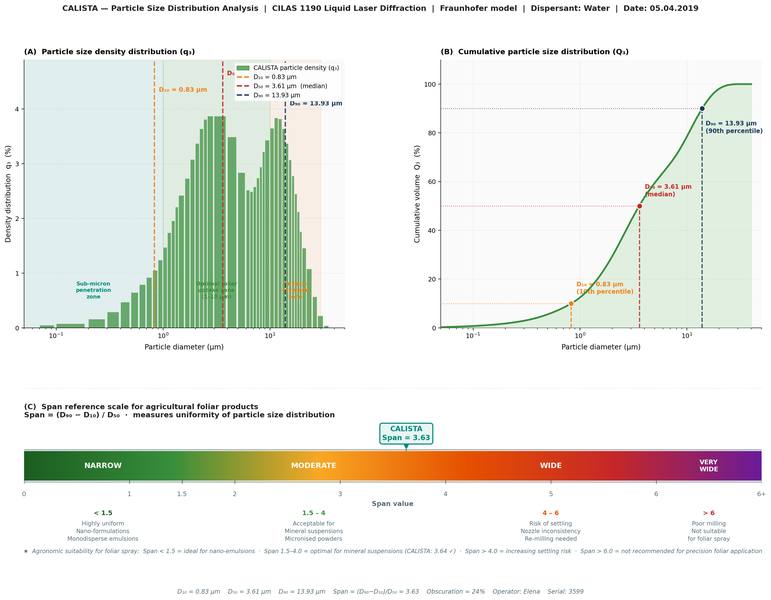
CALISTA particle size distribution (CILAS 1190 Liquid, Fraunhofer model). (A) Density distribution q₃. (B) Cumulative Q₃. (C) Span reference scale for agricultural foliar products — CALISTA Span = 3.64 in the moderate-acceptable zone.
Sub-micron fraction (D₁₀ = 0.83 µm)
~12% of particles below 1 µm penetrate the cuticle directly through aqueous pores — fastest Ca²⁺ signalling activation.
Stomatal uptake fraction (D₅₀ = 3.61 µm)
Median particle within the stomatal pore range (5–15 µm), enabling direct stomatal entry and rapid apoplast delivery.
Surface barrier fraction (D₉₀ = 13.93 µm)
Coarser particles remain on the leaf surface, building the permanent Si barrier against thrips and aphid mechanical penetration.
Nozzle compatibility
No particles above 32 µm — compatible with all standard flat-fan nozzles (ISO 110-03 and finer). Continuous tank agitation required.
Product synergy
CALISTA + AMINOSUN — ROS Defence
Two products. Two entry points. One shared pathway. CALISTA and AMINOSUN target ROS from complementary angles — connected through the Halliwell-Asada ascorbate-glutathione cycle.
Upstream: pre-arming the enzymes
Si upregulates SOD, CAT, APX and GR antioxidant enzymes. These intercept ROS before membrane damage occurs. Ca²⁺ amplifies all antioxidant gene expression.
- SOD: converts O₂•⁻ → H₂O₂
- CAT + APX: destroy H₂O₂ → H₂O
- GR: regenerates GSH from GSSG (needs NADPH)
- APX requires ascorbate — which requires GSH
Downstream: supplying the fuel
AMINOSUN delivers Glu (8.30 g) + Cys (0.84 g) + Gly (8.00 g) — the three building blocks of glutathione (γ-Glu–Cys–Gly). GSH scavenges residual H₂O₂ and regenerates ascorbate for APX.
- Cystine is the rate-limiting precursor (Liebig's law)
- GSH regenerates ascorbate via DHAR enzyme
- Ascorbate fuels the APX that CALISTA activated
- GR (upregulated by CALISTA-Si) recycles GSSG → GSH
The molecular dependency
CALISTA activates the APX engine. AMINOSUN supplies the GSH fuel APX requires to keep running. Without GSH, CALISTA-primed APX stalls. Use both together for maximum stress protection.
Practical guidance
Application Guide
Prepare suspension
Add CALISTA to water with continuous mechanical agitation. Mix 2–3 min. Never allow suspension to stand without agitation.
Application rate
1.5–3.0 kg/ha per application. 3–5 applications per season, starting at early vegetative stage.
Spray conditions
Early morning or evening, temperature below 25°C. Fine mist flat-fan nozzles (ISO 110-03 or finer). Avoid rain or high wind.
Repeat interval
Every 10–14 days, or after heavy rainfall (>20 mm) that may wash off the Si surface deposit.
Tank agitation
Continuous return-flow agitation required during spraying. Rinse equipment immediately after use. Filter with >0.1 mm mesh screen.
Recommended crops
Compatibility
Compatible with most foliar fertilisers and crop protection products. Always perform a jar test before the first tank-mix. Avoid mixing with strongly acidic products (pH <4). Spray water pH 6.0–7.5 recommended.
Packaging & Storage
1 kg · 5 kg · 10 kg · 25 kg sealed bags · Shelf life: 36 months from production date · Store <25°C, dry, away from moisture and direct sunlight.
Technical documentation & further information
Contact our technical team for the full TDS, SDS, ICP-OES data, greenhouse trial report and trial sample availability.
Information provided here reflects our current knowledge and describes the product for possible applications. It does not release the user from their own testing and does not constitute a binding assurance of properties. Permitted claims and regulatory status differ by country.
Industriestr. 1, 31180 Giesen, Germany · Zenith@zenith-tech.de · +49 55129131818 · zenith-tech.de