
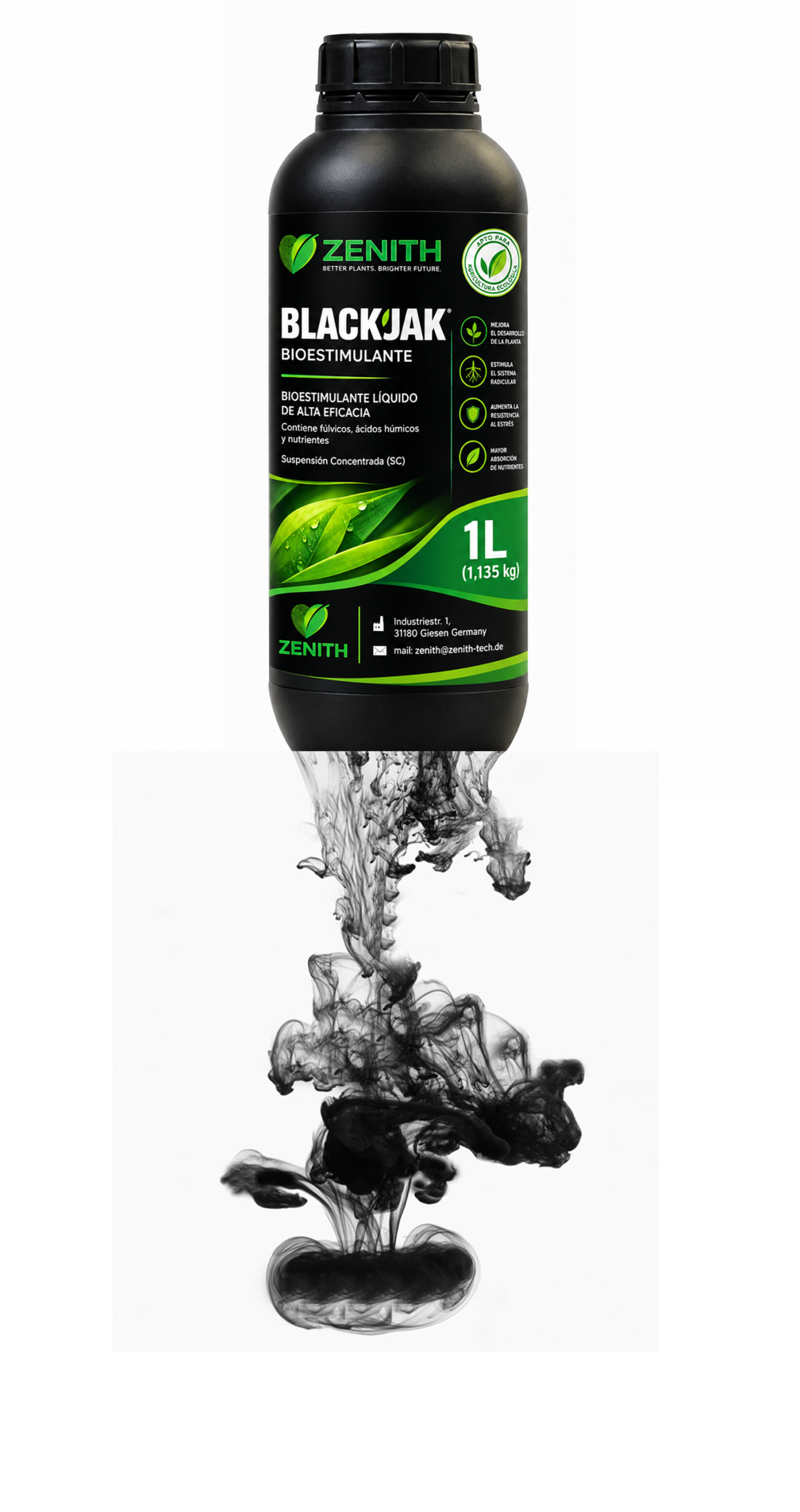
ZENITH BLACKJAK®
Liquid humic biostimulant — a concentrated suspension of pure, chemically unmodified humus from natural leonardite
Humic · Fulvic · Ulmic · Humin
Foliar & fertigation
Suspension Concentrate (SC)
Suitable for organic farming
Most humic products on the market are humates — alkaline salts, pH above 9, containing only the
humic and fulvic fractions. ZENITH BLACKJAK is different on both counts: it delivers the complete humic
spectrum at an acidic pH of 4 – 5, so the active molecules reach the plant in their
original free-acid form rather than as salts.
Why the full humic spectrum matters
Natural humus contains four main groups of substances, each with a different solubility — which is exactly why
most manufacturers extract only part of it:
| Fraction | Solubility | Role in the plant–soil system |
|---|---|---|
| Humic acids | Soluble in alkali only | Soil activator — improves structure, buffering and cation exchange |
| Fulvic acids | Soluble in alkaline and acidic solutions | Nutrient carrier — mobilises and transports nutrients |
| Ulmic acids | Soluble in alcoholic solution of humic acids | Natural chelating agent — ionises metals, stimulates root development |
| Humin | Insoluble in alkali and acid | Direct plant activator — absorbed and transported by the vascular system |
Because full extraction is technically demanding, most preparations available are humates: salts of only the
humic and fulvic fractions, obtained by extraction with potassium or sodium alkali, with an alkaline pH above 9.
ZENITH BLACKJAK was developed to deliver something more complete — an acidic concentrated
suspension (pH 4 – 5) containing not only humic and fulvic acids but also ulmic acids and humin,
together with the other beneficial nutrients naturally present in leonardite.
Indirect action — the soil
Humic and fulvic acids work as soil activators, stimulating the metabolism of soil microorganisms and the
dynamics of nutrient cycling. This is what conventional humates deliver.
Direct action — the plant
Ulmic acids and humin act as plant growth activators at the level of metabolism and of hormonal and
enzymatic processes. Certain components of humin are absorbed and transported directly by the vascular system
and catalyse numerous metabolic processes.
Why the acidic pH is the real advantage
An alkaline humate has to be neutralised by the soil or the leaf surface before it can do much. ZENITH BLACKJAK
arrives already acidic, and that changes four things:
- Micronutrients stay available. Iron, manganese, zinc and copper are far more soluble at low pH.
In the calcareous, high-pH soils common across the Mediterranean, the Middle East and North Africa, these elements
are chemically locked up — an acidic humic input helps release them in the root zone. - Phosphorus is freed. In alkaline soils phosphate is bound as insoluble calcium phosphate.
Local acidification around the root, combined with the chelating action of the humic and ulmic fractions, helps
bring it back into solution. - Better foliar uptake, gentler on the leaf. Slightly acidic spray solutions favour penetration
through the leaf cuticle, and they do not carry the leaf-scorch and tank-mix instability risk that comes with
strongly alkaline products. - Cleaner irrigation lines and safer tank mixes. An acidic product does not precipitate with
micronutrients or phosphates in the mixing tank, and helps keep drip emitters free of lime scale, rather than
contributing to the blockages that alkaline products can cause.
The humic substances themselves then raise the cation exchange capacity of the soil once
incorporated — holding potassium, calcium, magnesium and ammonium against leaching and releasing them to the crop as
it needs them. This is the long-term soil benefit that sits on top of the immediate uptake effect.
Delivering the humic and fulvic acids in their original free-acid form rather than as potassium or sodium
salts is what makes ZENITH BLACKJAK markedly more active than a humate in foliar application — and equally
effective through drip irrigation.
The suspension is stable and free-flowing, passing through spray nozzles and drip emitters without clogging,
in both foliar application and drip irrigation.
What the research shows
Humic substances are among the most thoroughly studied inputs in plant nutrition. The figures below come from
independent, peer-reviewed research on humic and fulvic acid applications — including a meta-analysis that pooled
more than four hundred published trials.
meta-analysis, ±4 %
meta-analysis, ±6 %
tomato, foliar application
sweet potato

Advances in Agronomy — shoot dry weight +22 ± 4 %, root dry weight +21 ± 6 %; humic-like substances applied
foliarly to tomato (2025); humic-acid urea on sweet potato (2017); humic acid biostimulant applied foliarly to
sugarcane. These results come from independent published research on humic substances in general and are not trials
of this product. Field response varies with soil type, crop, climate and application method.
The mechanism behind these numbers is consistent across studies: humic substances stimulate plasma membrane
H⁺-ATPase activity, and the lower molecular weight fractions penetrate plant cells to act as signalling molecules.
The result is a coordinated increase in both root and shoot growth rather than one at the expense of the other.
Much more than a humate
- Improves plant development and vigour
- Stimulates development of the root system
- Increases resistance to abiotic stress
- Acidic pH 4 – 5 — roots absorb better and faster
- Greater absorption and use of nutrients
- Improves soil structure and microbial activity
- Activates cation exchange of macro- and micronutrients
- Natural leonardite origin, with naturally occurring nutrients
- Ulmic acid and humin activate root and vegetative growth
- Acts as a natural chelating agent throughout the plant
- Enhances uptake of nutrients penetrating the leaves
- Does not clog spray nozzles or drip emitters — superior solubility
- Suitable for seed treatment, drip irrigation and foliar use
Composition
| Content | % w/w |
|---|---|
| Total Humic Extracts 1 | 22 – 26 |
| Humic Acid 1 | 19 – 21 |
| Fulvic Acid 1 | 3 – 5 |
| Potassium Oxide (K2O) | 4 |
| Property | Value |
|---|---|
| Organic Matter | 23 % |
| Organic Carbon | 7.3 % |
| pH | 4 – 5 |
| Density (20 °C) | approx. 1.135 g/cm3 |
1 Humic and fulvic fractions determined according to ISO 19822
(International Humic Substances Society reference method). ISO 19822 is the internationally recognised standard for
the quantification of humic and fulvic acids in fertilizer materials, and is the figure on which this product is
guaranteed.
How to use
| Application method | Guidance | Rate |
|---|---|---|
| Drip irrigation / fertigation | Apply through the season at regular intervals. Shake well before use. | 5 – 15 L/ha per season |
| Foliar application | Apply to an actively growing crop; avoid the hottest hours of the day. | 1.5 – 3 L/ha per application |
| Seed treatment | Dilute before use and treat evenly. | 0.5 – 2 L per tonne of seed |
| Soil application at planting | Apply to the root zone. | 10 – 20 L/ha |
Rates are guidance only. Adjust to crop, growth stage, soil analysis, water quality and local
agronomic practice. Always carry out a small-scale trial before large-scale use.
Compatibility
Compatible with most macro- and micronutrients and with plant protection products. Because ZENITH BLACKJAK is
acidic (pH 4 – 5) it is more tank-mix tolerant than alkaline humates — it will not precipitate micronutrients or
phosphates in the mixing tank. A jar test must still be carried out before any new mixture, and the product should
not be combined directly with strongly alkaline products.
Packaging and storage
Available in 1 L (1.135 kg), 5 L and 20 L containers and 1000 L IBC. Store in the original closed container in a
cool, dry, well-ventilated place between 5 °C and 30 °C, protected from direct sunlight and frost. Shake well before
use; natural sedimentation does not affect product quality. Shelf life 24 months from date of manufacture.
Need technical advice or a quotation?
Our agronomy team will help you build the right programme for your crop.