
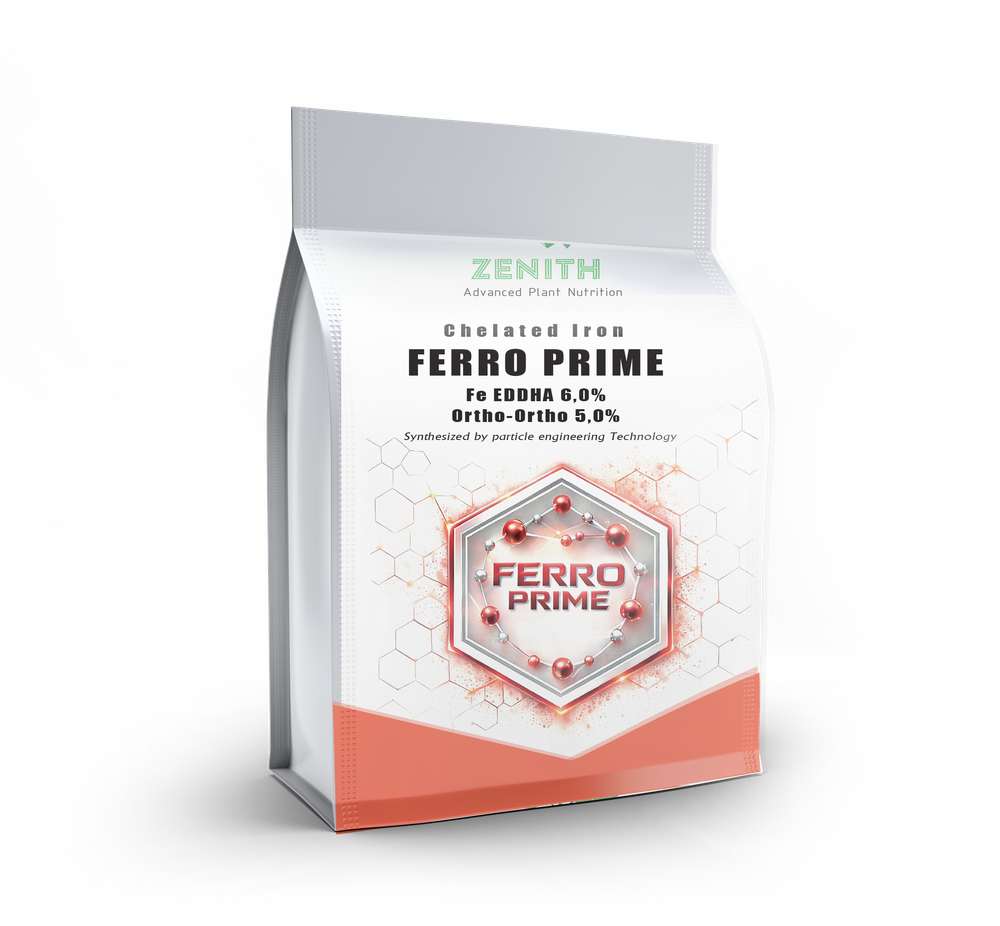
FERRO PRIME
Chelated iron that is still chelated when it reaches the root, on soil where every
other iron source has already failed.
ortho-ortho EDDHAof 6.0 % total iron, fully chelated
Calcareous soil can contain iron — while still limiting iron availability.
A calcareous soil can hold several percent iron by weight and still starve the crop. Above pH 7 the ferric
ion oxidises to iron hydroxide, which is effectively insoluble. Roots sit surrounded by iron they cannot
reach, and the grower sees interveinal yellowing on the youngest leaves, short shoots, poor set, and a yield
gap that returns every season.
Broadcasting iron sulphate onto that soil changes nothing: it precipitates within hours of contact. A
chelate is different. It encloses the iron ion in an organic cage and holds it in solution. The only
question that matters is how much pH the cage can take before it lets go.
Fe³⁺ coordination by EDDHA
EDDHA is hexadentate. It grips the ferric ion at six points at once — two phenolate oxygens, two
carboxylate oxygens and two amine nitrogens — which is why calcium cannot displace it in the way it
displaces EDTA at high pH.
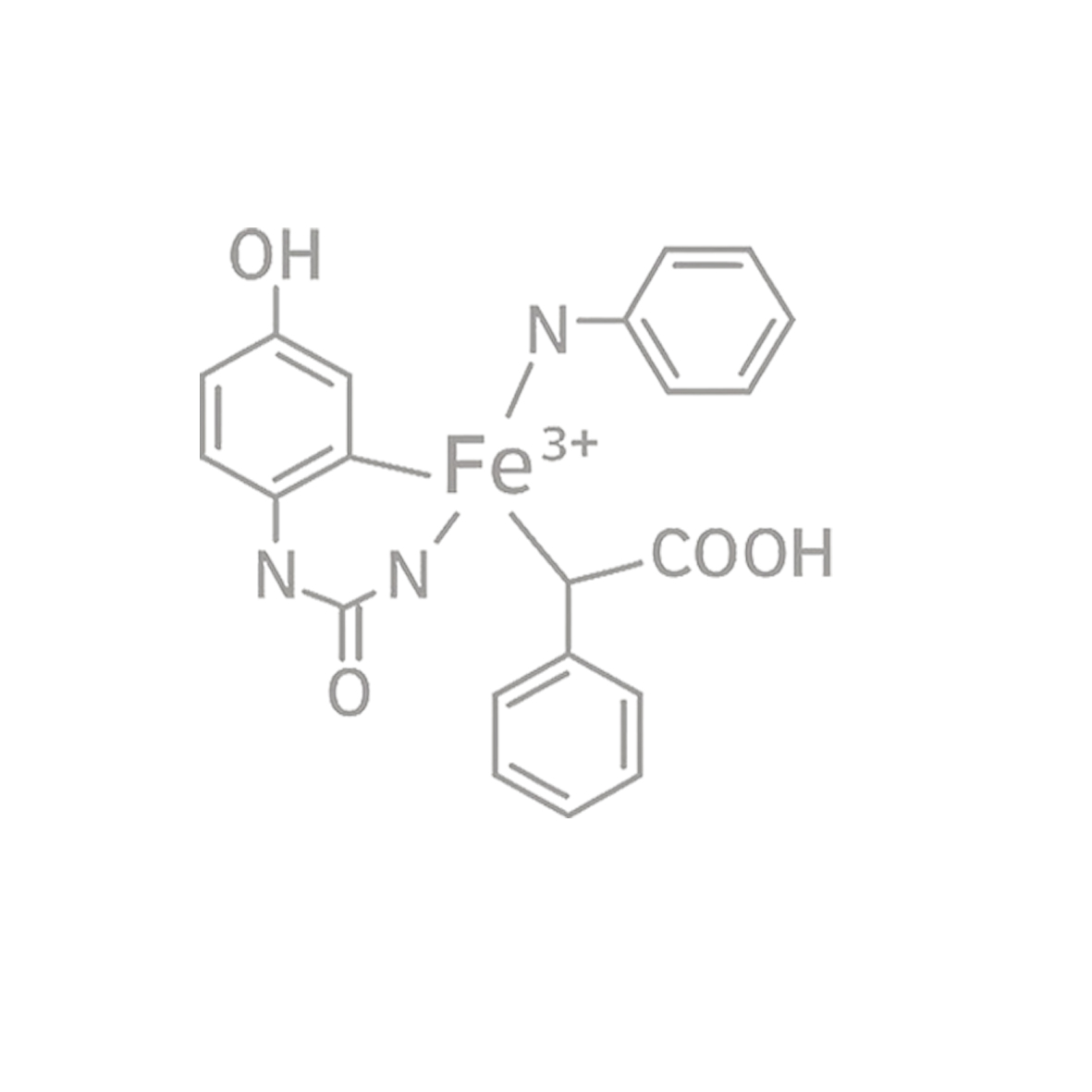
- Phenolate oxygen — the bond that survives high pH
- Amine nitrogen — closes the cage around the ion
- Carboxylate oxygen — holds the complex in solution
- Aromatic backbone — rigid, resists hydrolysis
Chelate stability across soil pH
The stability constant is the number to compare. Fe-EDDHA sits around log K 35, against roughly 28 for
DTPA and 25 for EDTA — and because the scale is logarithmic, those gaps are orders of magnitude, not
percentages. In practice the difference shows up as a hard ceiling in soil pH.

actually appears. Fe-EDDHA in the ortho-ortho form holds iron in solution to pH 10, which covers the whole
calcareous range.
Specify the EDDHA isomer profile
Manufacturing Fe-EDDHA produces two isomers. Only the ortho-ortho form is fully stable at high pH and
biologically active in the way the label implies; the ortho-para form contributes, then breaks down sooner.
A product that declares total EDDHA alone tells you nothing about the ratio between them — and the ratio is
where the money goes. Ferro Prime declares both.
The two isomers together are the 6.0 % declared iron. They are not
additional to it.
- Total water-soluble iron (Fe)
- 6.0 % · 60 g/kg
- chelated by [o,o]-EDDHA
- 5.0 % · 50 g/kg
- chelated by [o,p]-EDDHA
- 1.0 % · 10 g/kg
- Chelated fraction of declared iron
- 100 %
- Water-insoluble matter
- ≤ 0.1 %
- Chloride
- ≤ 0.1 %
- Chelate stability in soil
- pH 2 – 10
- Physical form
- Dustless microgranulate
- Colour
- Dark red to near-black
- Particle size, d50
- 0.2 – 1.0 mm
- Solubility at 20 °C
- ≥ 120 g/L
- Solubility at 5 °C
- ≥ 80 g/L
- Bulk density
- 0.65 – 0.85 g/cm³
- pH, 1 % solution
- 7.0 – 9.0
Sodium ferric ethylenediamine bis-(2-hydroxyphenylacetate), CAS
16455-61-1. EU fertilising product under Regulation (EU) 2019/1009, PFC 1(C)(II)(a), mineral single-nutrient
micronutrient fertiliser. Approved for use under the EU Organic Regulation (EU) 2018/848. Professional use
only.
Application rates
Apply where iron deficiency is confirmed, or where calcareous, high-pH soil makes it likely. The lower
figure is preventive, for young plants and sensitive crops; the higher figure corrects visible chlorosis.
On drip and trickle systems reduce by a fifth to a quarter, and split the season’s dose across three
fertigation events or more.
| Vines, fruit and berries | Young, to first yield | Established |
|---|---|---|
| Grapevine | 3 – 7.5 g/plant | 10 – 20 g/plant |
| Apple, pear | 15 – 40 g/plant | 40 – 80 g/plant |
| Apricot, cherry, plum, mirabelle | 5 – 30 g/plant | 30 – 60 g/plant |
| Peach | 10 – 60 g/plant | 60 – 100 g/plant |
| Raspberry, currant | 75 – 150 g/100 m² | 150 – 300 g/100 m² |
| Strawberry | 200 – 400 g/100 m² | 200 – 400 g/100 m² |
| Vegetables, ornamentals, nursery | Rate | Notes |
|---|---|---|
| Short-cycle vegetables | 60 – 100 g/100 m² | Fertigation, as required |
| Long-cycle and perennial vegetables | 75 – 150 g/100 m² | Fertigation, as required |
| Cut flowers | 200 – 500 g/100 m² | Irrigate at up to 0.2 % |
| Rose beds, cut | up to 750 g/100 m² | Split across several irrigations |
| Nursery stock, area | 300 – 500 g/100 m² | Establishment phase |
| Roses, nursery trees, containers | 20 – 50 g/plant | Or 30 – 60 g per m³ substrate |
| Hydroponics | Product per 1 000 L |
|---|---|
| 1 mg Fe/L | ≈ 17 g |
| 1 – 5 mg Fe/L, working range | 15 – 80 g |
| Stock solution | max. 7.5 % |
Recirculate no more than two or three times a day to limit
oxidation, and keep tanks out of direct sunlight — UV breaks the chelate down.
Using it
Dissolving
Add the microgranules to water that is already moving; never pre-mix them as a dry
blend. Stir for five to ten minutes. Maximum 0.2 % (2 g/L) for direct application, up to 7.5 % for a
stock solution. A correct solution is clear orange-red with nothing settled at the bottom.
Placing it
Soil drench or fertigation to the root zone is the method that works. Broadcast
granules must be watered or cultivated into the top five to ten centimetres straight away. For deep-rooted
perennials, inject the solution into the root-feeding zone under pressure.
intensely, at concentrations far below the rate that would do any good. Use a foliar-grade iron product
where a leaf application is needed.
Storing it
Frost-free above +2 °C, dry, out of direct light and heat, in the original sealed pack.
The granules take up moisture, so reseal an opened pack at once and use it promptly. Keep on pallets, no
more than two high. Shelf life at least two years sealed.
Supply
1 kg folding carton and 5 kg foil bag in an outer carton. Tariff number 3105 9099 90.
Safety data sheet on request (EUH210). Keep out of reach of children, do not eat, drink or smoke while
handling, and wear respiratory protection where ventilation is poor.
Send us your soil pH and a photograph of the affected crop, and we will tell you whether iron is
actually the problem before you buy anything.